EN
EN  NL
NL  BE
BE 
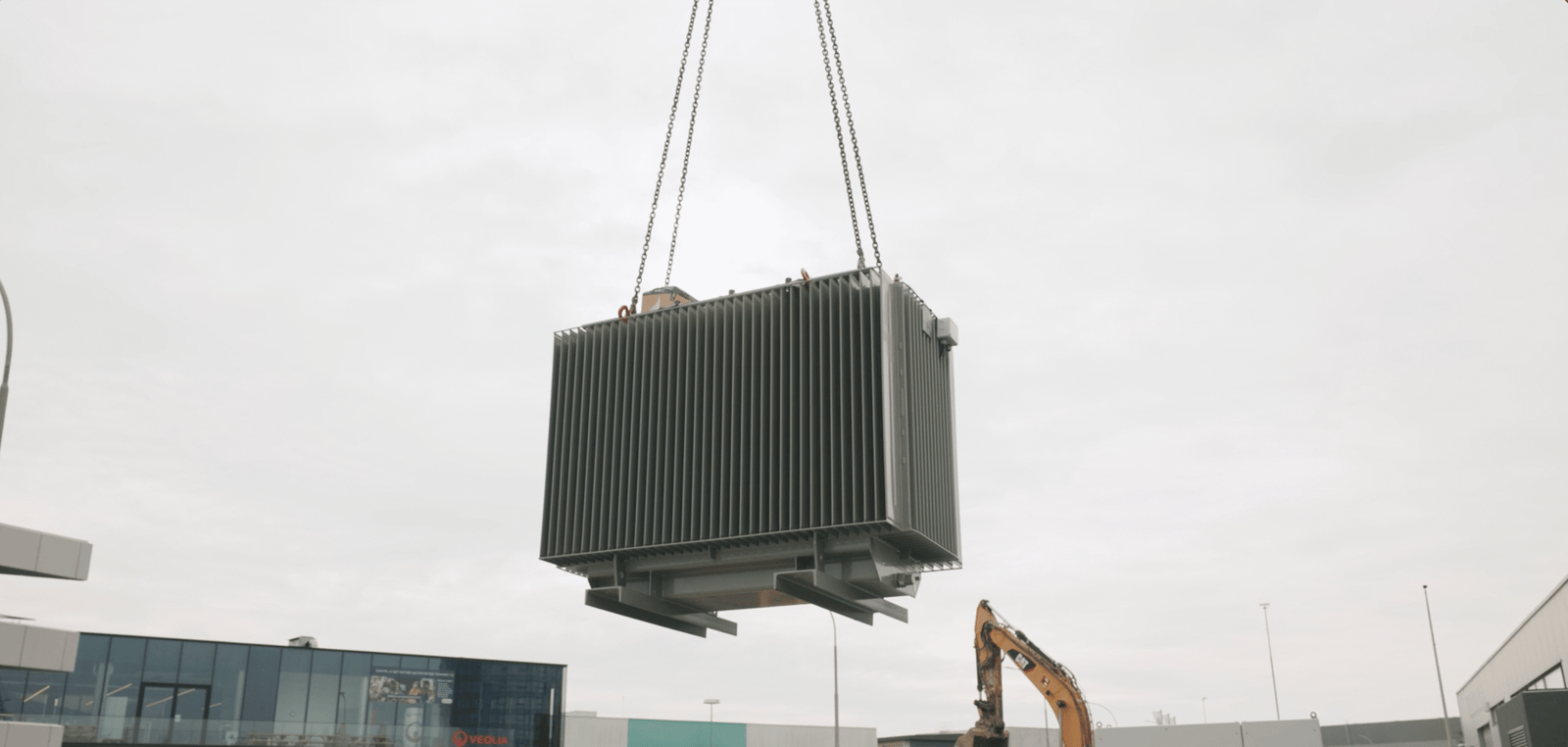
As a business grows, so does its power demand. At some point, an expanding production line, a new cooling installation, a fleet of EV chargers, or a data hall outgrows what a standard low voltage connection can deliver. That is the moment a medium voltage substation stops being a technical detail and becomes a business decision. This article explains what it is, when it becomes necessary, and how the right design choices today set the electrical backbone for the next twenty-five years.
What is a medium voltage substation?
A medium voltage substation is the facility, either a prefabricated outdoor enclosure or an integrated room inside a building, where electricity from the grid operator’s medium voltage network is transformed into the low voltage an installation actually uses. It sits between the public grid and a site’s own electrical installation, and it is where grid risk and site reliability meet.
In Belgium this installation is commonly called a “hoogspanningscabine” (high voltage cabin), even though the voltage involved is technically medium voltage. In the Netherlands the same installation is called a “middenspanningsinstallatie” or “transformatorstation.” Internationally, “MV substation” or “MV/LV transformer station” are the standard terms.
Medium voltage versus high voltage
European standards define the split as follows:
- Low voltage, up to 1 kV AC, used in residential and small commercial settings.
- Medium voltage, from 1 kV to roughly 52 kV, the distribution level that feeds industrial and commercial sites.
- High voltage, above 52 kV, the transmission level operated by Elia in Belgium and TenneT in the Netherlands.
The installation that feeds a business site almost always operates in the medium voltage range, typically between 10 kV and 36 kV across the Benelux.
When is one required?
Grid operators typically require a medium voltage connection once peak demand exceeds the capacity of a low voltage service, which in practice means roughly 160 kVA and up depending on region and network operator. Common use cases include:
- Manufacturing and industrial facilities
- Data centers and server halls
- Logistics hubs with charging infrastructure for trucks or vans
- Large office or retail buildings with significant HVAC loads
- EV charging hubs
- BESS installations for self-consumption or grid services
There is also a commercial reason beyond the technical threshold: per-kWh network tariffs are meaningfully lower on medium voltage than on low voltage. For heavy consumers, the substation amortizes itself through the tariff structure over time.
What is inside the substation?
Every medium voltage substation consists of three technical sections:
- The medium voltage section, where the connection to the grid operator is made through switchgear and protection equipment.
- The transformer section, where medium voltage is stepped down to 400 V.
- The low voltage section, where distribution to the site begins, with protection, breakers, and metering.
Earthing, surge protection, ventilation, and mandatory signage complete the installation. The full system is designed and commissioned under AREI Book 2 in Belgium, NEN 1010 in the Netherlands, and the technical standards of the relevant grid operator.
Prefabricated or indoor?
Two configurations are standard. A prefabricated substation is a complete concrete or steel enclosure placed outside the building. It is fast to deploy, useful when indoor space is limited, and easy to separate visually and operationally from the main facility. An indoor substation is integrated into a dedicated technical room within the building. It is typically chosen for larger capacities, constrained sites, or when 400 V cable runs between transformer and main distribution board need to be kept short to limit copper losses.
The right choice depends on power demand, building layout, growth plans, and budget. Reeload delivers both configurations, and the decision is made jointly with the client based on a concrete site analysis.
In closing
A medium voltage substation is not a technical detail. It is the electrical backbone of a business that depends on reliable, scalable power. Sites designed today for the demand of five years out, with headroom for charging infrastructure, storage, and electrification, stand on infrastructure that lasts twenty-five years or more.
If you are planning a new substation, or weighing options for an existing site, talk to our team.